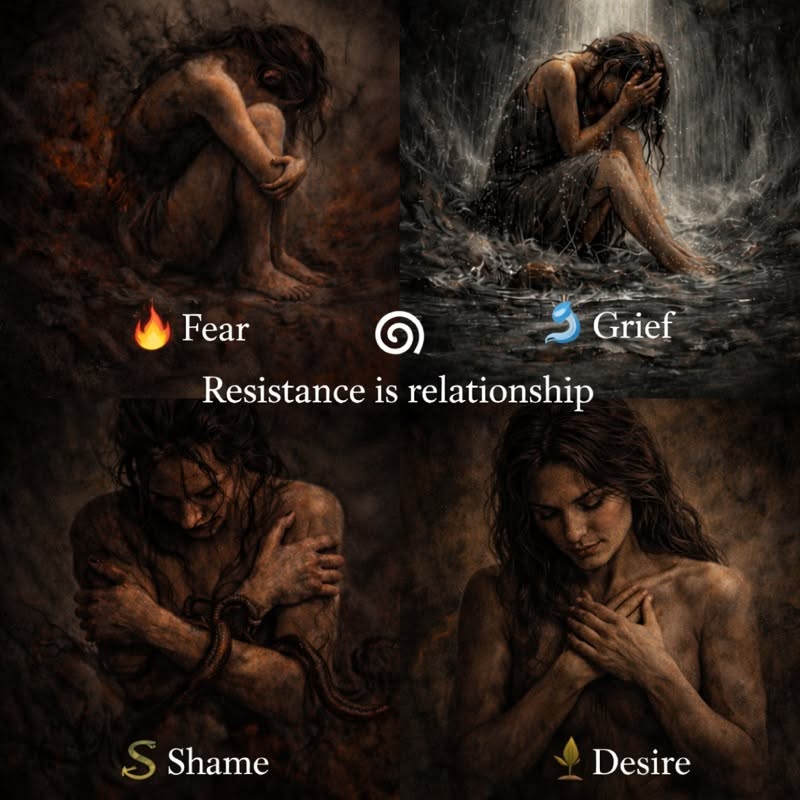
Resistance is Relationship
When we fight against something internally — fear, grief, shame, desire — we split. A part of us becomes the judge, the gatekeeper, the denier. And the other part — the emotion or impulse itself — becomes the enemy.
But here's the paradox:
🌪 Resistance is relationship.
To resist something is to be in constant contact with it. You're holding it in place, even if the grip is unconscious.
It's like trying to push a beach ball underwater: the harder you press, the more tension builds — and eventually, it snaps back up with even more force.
Let's unpack a few:
⸻
🔥 Fear
When you resist fear, you brace. You tighten. You monitor for it. You try to control situations so fear doesn't arise — which ironically fuels more anxiety.
But when you turn toward fear — breathe with it, ask it what it needs — it often softens, because it's no longer being cast out like a monster under the bed.
Fear is not the enemy. Fear is a signal.
It alerts you to edges, thresholds, moments that matter. Fear sharpens attention. It mobilises energy. It prepares the nervous system for action.
When befriended, fear becomes discernment. It can tell you where to slow down, where to be alert, or where courage is required.
For example: Fear before a difficult conversation may not mean "don't speak" — it may mean speak carefully, honestly, and with presence.
⸻
🌊 Grief
When you resist grief, it doesn't disappear — it sinks. It gets buried in the body, becoming fatigue, numbness, tension, illness.
Grief wants to move. It's not trying to destroy you — it's trying to complete.
Grief is the nervous system digesting loss. It's how love exits the body when what it loved is gone.
When allowed, grief cleanses. It softens the heart. It deepens compassion. It reconnects us to what truly matters.
For example: Unexpressed grief can harden into cynicism or withdrawal. But felt grief often reopens tenderness — making space for meaning, connection, and reverence.
⸻
🐍 Shame
Shame grows in secrecy. When we resist it, we create internal prisons.
We loop: "I shouldn't feel this…" "What's wrong with me for feeling this…"
That's meta-shame — shame about shame.
Shame, at its root, is a belonging signal. It developed to keep us connected to the group — to ask, "Am I still accepted?"
When met with compassion, shame loses its grip. Not through fixing — but through witnessing.
For example: When shame is hidden, it isolates. When spoken aloud in a safe space, it often dissolves — revealing not defectiveness, but unmet needs and old wounds.
⸻
🌱 Desire
Desire, especially when it was unheld or unwelcome early on, becomes distorted when resisted. It can twist into obsession, suppression, or confusion.
But desire itself isn't the problem.
Desire doesn't always tell you what to do — it tells you what to listen to.
It highlights where energy is alive, where attention keeps returning, where something in you wants expression or connection.
Often, desire isn't about the action at all — it's pointing toward needs for closeness, aliveness, truth, or creativity that want recognition.
⸻
🌀 So what's the alternative to resistance?
Not indulgence. Not collapse.
But curiosity. Compassionate turning-toward.
Instead of saying, "No. Get away," try asking:
"What are you here for? What do you want me to know?"
Most of these inner forces — fear, shame, grief, desire — are like exiled children.
They don't need to be banished. They need to be met.
Because every time you say, "I can't feel this," your soul hears, "I can't be me."
But when you turn toward the feeling, 💫 you reclaim a part of your soul. 🕯
Aho 🦅
Continue Your Journey